
FDA Consulting and Compliance
FDA Compliance Explained
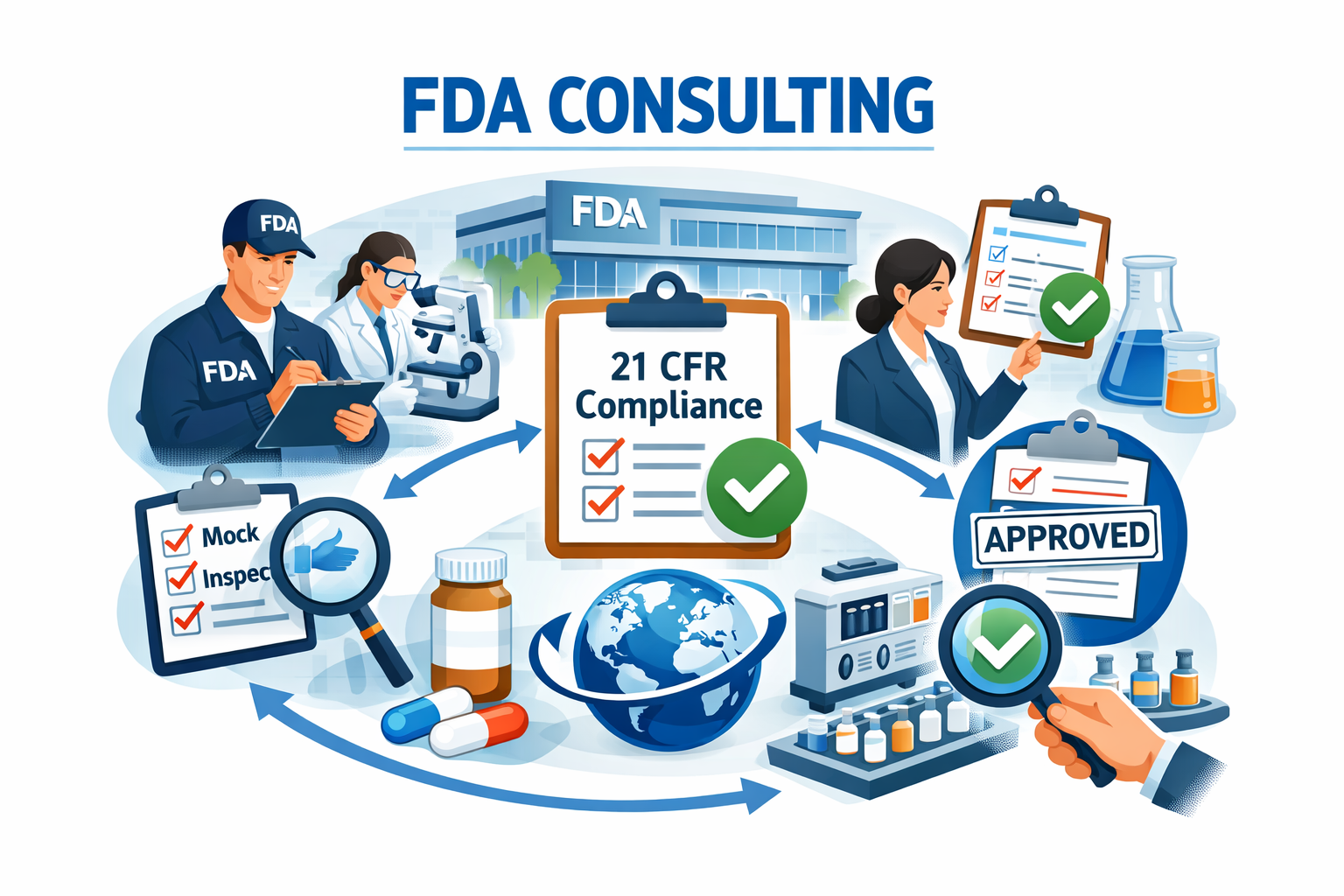
FDA compliance is not just following procedures—it is demonstrating control, consistency, and objective evidence across your operations. Medical device and pharmaceutical manufacturers must meet strict regulatory requirements under 21 CFR. However, many systems that work internally fail under FDA inspection. This is where FDA consulting becomes critical. FDA consultants bring an independent perspective aligned with how FDA actually evaluates compliance. They identify gaps, challenge assumptions, and ensure your systems are inspection-ready. The goal is not just compliance on paper, but systems that hold under real FDA scrutiny. FDA consulting bridges the gap between internal practice and regulatory expectation.
When it comes to FDA compliance, budget should not be the primary driver. The impact of noncompliance can be significant—creating costly disruptions for small and mid-sized manufacturers and meaningful operational and financial challenges for larger organizations.

Quality, Compliance, Regulatory, and Legal: Different Roles, One Outcome
Quality teams often carry the day-to-day responsibility for compliance, but they are not the same function. Quality focuses on systems, procedures, and execution. Compliance ensures those systems align with regulatory requirements and inspection expectations. Regulatory Affairs manages submissions, product approvals, and ongoing regulatory strategy. Legal addresses risk, liability, and enforcement exposure.
If your organization does not have a dedicated compliance function, FDA consulting can serve as an ongoing extension of your team—not just a one-time solution. This includes continuous oversight, periodic gap assessments, and ongoing alignment with FDA expectations.
Rather than reacting to issues, a long-term approach allows you to identify risks early, maintain inspection readiness, and strengthen your quality system over time. FDA expectations evolve, and so do your operations. Without continuous review, gaps will reappear.
A structured FDA consulting engagement provides consistent support, independent perspective, and accountability—ensuring your systems remain compliant, defensible, and ready for inspection at any time.
Quality
The quality function is responsible for building and maintaining the systems that support compliance. This includes procedures, document control, training, CAPA, change control, and validation activities. Quality ensures processes are defined, followed, and documented consistently. However, quality often focuses on internal execution—making sure the system works as designed. The gap occurs when “working” internally does not align with how FDA evaluates compliance. A strong quality system is the foundation, but without alignment to regulatory expectations, it may still fail during inspection. Quality alone cannot carry full compliance without external perspective or regulatory alignment.
Compliance
Compliance focuses on whether your systems meet regulatory expectations—not just whether they function internally. It bridges the gap between quality execution and FDA requirements. Compliance evaluates if procedures, records, and actions hold up under inspection, including traceability, consistency, and objective evidence. This function requires understanding how FDA interprets regulations in real-world situations. Many organizations lack a dedicated compliance role, leaving gaps unnoticed until inspection. FDA consulting often fills this role by providing independent oversight, identifying risks, and ensuring alignment with actual FDA expectations. Compliance is about defensibility, not just functionality.
Regulatory Affairs
Regulatory Affairs manages the interface between your organization and regulatory authorities. This includes submissions, product approvals, labeling, and ongoing regulatory strategy. Regulatory ensures that products meet requirements for market entry and remain compliant throughout their lifecycle. However, regulatory focus is often external—centered on submissions and approvals—rather than day-to-day operational compliance. While critical, it does not replace the need for internal system alignment. A strong regulatory strategy must be supported by compliant execution within the quality system. Without that alignment, approved products can still face compliance issues during FDA inspection.
Legal
Legal plays a critical role when compliance issues escalate into regulatory or enforcement risk. This includes advising on liability, managing communications with regulators during enforcement actions, and protecting the organization’s legal interests. Legal becomes especially important during warning letters, consent decrees, or investigations. However, legal is typically reactive—engaged after a problem has been identified. It does not build or maintain compliance systems. Strong organizations involve legal appropriately but do not rely on it for compliance execution. FDA consulting helps prevent situations from reaching legal exposure by identifying and addressing gaps early, before they escalate.
FDA Consulting as an Extension of Your Team
FDA consulting should not be limited to one-time projects or reactive support. The most effective approach is to integrate consulting as an extension of your team—providing continuous oversight, independent assessment, and ongoing alignment with FDA expectations.
This model moves beyond fixing isolated issues. It focuses on maintaining inspection readiness at all times, identifying risks early, and ensuring your quality system evolves with your operations. Internal teams manage daily execution, but an external perspective ensures those activities remain compliant and defensible under FDA scrutiny.
Rather than reacting to problems after they surface, this approach builds consistency, accountability, and long-term control. FDA consulting becomes part of your system—not an afterthought when issues arise.
Why Leadership Invests in FDA Consulting
FDA compliance is not just a quality issue—it is a business decision. Leadership teams invest in FDA consulting to gain clarity, reduce uncertainty, and make informed decisions about risk, timing, and resources. Internal teams may understand the system, but leadership needs an objective view of where the organization truly stands.
FDA consulting provides that visibility. It translates complex regulatory expectations into actionable priorities, helping leadership focus on what actually matters during an inspection. This prevents over-investment in low-risk areas and under-preparation in high-risk ones.
Ultimately, FDA consulting supports better decisions—ensuring resources are directed where they have the greatest impact on compliance, inspection readiness, and long-term stability.
Clear Visibility Into Compliance Status
Leadership often relies on internal reporting, which may not fully reflect inspection reality. FDA consulting provides an independent assessment of your true compliance position. This clarity allows leadership to understand actual risk, not perceived risk, and make informed decisions without assumptions or bias.
Better Allocation of Resources
Not all compliance issues carry the same risk. FDA consulting helps prioritize efforts based on what FDA is most likely to focus on. This prevents wasted time and budget on low-impact activities and ensures critical gaps are addressed first, improving efficiency and outcomes.
Alignment Across Functions
Quality, regulatory, and operations may have different priorities. FDA consulting helps align these functions around a single goal—inspection readiness. This reduces internal conflict and ensures consistent execution across departments, which FDA expects during inspection.
Confidence in Inspection Readiness
Uncertainty is one of the biggest risks before an FDA inspection. FDA consulting gives leadership confidence that systems are not only in place, but effective. This confidence comes from independent validation, not internal assumption.
Speak With an FDA Consultant Before FDA Does
Most companies don’t lack effort—they lack clarity on how FDA will interpret what they’ve built. That gap only becomes visible during an inspection. By then, you’re no longer preparing—you’re responding.
Speaking with an FDA consultant early changes that dynamic. It gives you a direct view of how your systems will be questioned, where decisions may be challenged, and whether your evidence will hold. This is not about adding more work. It is about focusing on what actually matters to FDA.
The value is simple: fewer surprises, better decisions, and stronger control over your operations. You stay ahead of the inspection instead of reacting to it.
If there are areas you’re unsure about, that uncertainty is the starting point—not something to ignore.
See Your System the Way FDA Will
Most organizations evaluate their systems based on internal logic—what makes sense operationally. FDA does not. They follow data trails, question inconsistencies, and assess whether your evidence supports your decisions. What appears controlled internally can quickly unravel under inspection. FDA consulting shifts your perspective from internal comfort to external scrutiny. It exposes how your records, CAPA, validation, and decisions will actually be interpreted. This is where most companies get caught off guard. Seeing your system through FDA’s lens early gives you the opportunity to correct weaknesses before they are formally documented as observations.
Eliminate Uncertainty Early
Uncertainty is where risk lives. If your team is unsure how FDA will view a process, a decision, or a record, that gap will surface during inspection. Waiting does not resolve uncertainty—it amplifies it. FDA consulting helps you address those unknowns directly, with clarity based on real inspection experience. This is not about over-preparing; it is about removing ambiguity. When expectations are clear, decisions become easier, responses become stronger, and your team operates with confidence. Early clarity allows you to act deliberately, rather than being forced to respond under pressure when FDA is already in your facility.
Focus on What Actually Matters
Not all compliance activities carry equal weight. Many organizations spend time building systems that look complete but miss what FDA actually prioritizes—data integrity, CAPA effectiveness, validation, and traceability. FDA consulting helps you cut through that noise. Instead of adding more procedures or documentation, the focus shifts to the areas that directly impact inspection outcomes. This targeted approach improves efficiency and reduces wasted effort. It ensures your resources are applied where they matter most. Strong compliance is not about doing more—it is about doing the right things well, consistently, and in a way that holds under FDA review.
Spend Resources Where They Matter Most
Resources—time, people, and budget—are limited. Many organizations invest heavily in low-impact activities while overlooking areas FDA will actually scrutinize. FDA consulting helps you prioritize based on real inspection risk, not internal assumptions. It directs effort toward critical systems such as CAPA, validation, data integrity, and records that support your decisions. This prevents wasted effort and ensures meaningful return on your compliance investment.
Spending wisely is not about reducing cost—it is about allocating resources where they have the greatest impact. With clear priorities, your organization operates more efficiently, avoids unnecessary work, and strengthens compliance where it truly matters under FDA review.