
FDA Consulting Experts
What Is FDA Consulting?
Why FDA Consulting Is Not Optional
Even with strong internal subject matter experts, most manufacturers operate within their own systems, assumptions, and history. That’s the gap. FDA consulting brings external perspective shaped by exposure to multiple companies, inspection styles, and real enforcement actions. It’s not about knowledge—it’s about pattern recognition. What looks “acceptable” internally can fail under FDA scrutiny. Former FDA experience and global manufacturing exposure across devices, drugs, and combination products provide context you simply don’t get in one organization. FDA doesn’t evaluate intent—they evaluate execution. Consulting closes that gap before it becomes a 483 or warning letter.
Your in-house subject matter experts (SMEs) may not always have the full picture. Expertise is often built within a single system, product line, or company history, which can limit broader perspective.

Miracles Don’t Happen in This Business
In medical devices, pharmaceuticals, biologics, and IVDs, there is no room for chance. Manufacturing processes must be validated and controlled so that no defective product is ever released. This is not optional—it’s expected. While companies can react after the fact through recalls, field corrections, or responding to a Form 483, those actions are costly, disruptive, and often ineffective at fixing the root problem.
Compliance is not about reacting—it’s about preventing. Strong systems, real validation, and objective oversight are what protect both patients and your business.
This is where FDA consulting adds value. An external perspective brings fresh insight, identifies gaps early, and challenges assumptions. It’s not about replacing your team—it’s about strengthening it before problems surface during an FDA inspection.
What FDA Consultants Actually Do
FDA consultants don’t replace your team—they bring an independent, experienced perspective aligned with how FDA actually evaluates compliance. They assess your quality system, identify gaps, and align your operations with real inspection expectations, not internal assumptions.
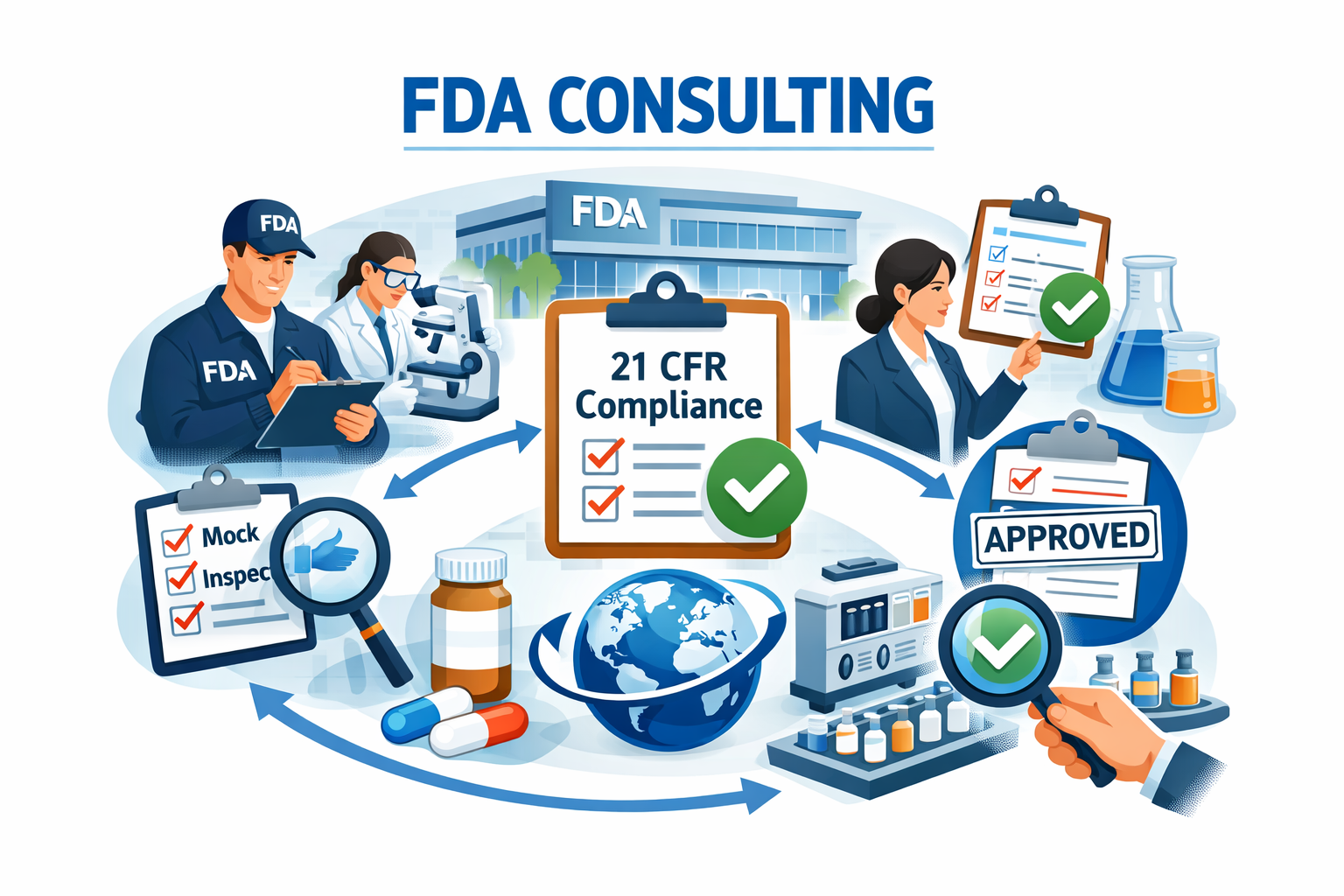
This includes mock FDA inspections, inspection readiness, CAPA effectiveness, root cause analysis, and review of critical systems such as design control, process validation, and data integrity. They focus on what FDA will actually look at, how they will question it, and whether your evidence holds.
They also support high-risk situations—483 response, warning letter remediation, and pre-approval inspection (PAI) readiness. The value is not just knowledge, but experience across multiple companies, products, and inspection outcomes.
Bottom line: they help ensure your systems stand up to FDA—not just to yourself.
When Do You Need FDA Consulting?
You don’t wait until FDA shows up. The need usually becomes clear at key risk points—startup phase, scaling operations, introducing new products, or entering the U.S. market. It becomes critical after receiving a Form 483, warning letter, or when preparing for a pre-approval inspection (PAI).
Companies also seek FDA consulting when internal teams are stretched, uncertain, or too close to the system to see gaps. What feels “under control” internally may not hold under FDA review.
The right time is before problems surface. Early engagement allows you to identify gaps, strengthen systems, and align with FDA expectations proactively—rather than reacting under pressure during or after an inspection.
The Sooner You Start, the More You Can Fix
The earlier you engage FDA consulting, the more time you have to identify, assess, and properly correct gaps. Building a compliant system is not a quick fix—it requires validation, documentation, training, and verification that corrections are effective. Last-minute remediation often results in superficial fixes that fail under FDA scrutiny. Early engagement allows you to address root causes, strengthen your quality system, and generate objective evidence over time. FDA looks for consistency and sustainability, not rushed corrections. The more time you have, the more credible your system becomes. Waiting limits your options and increases the risk of observations.
FDA Can Come at Any Time
FDA inspections, especially for medical device manufacturers, are often unannounced. You do not get advance notice to prepare your documents, align your team, or fix known issues. When FDA arrives, your systems, records, and personnel must already be inspection-ready. Companies that rely on last-minute preparation are typically exposed quickly. Inspection readiness must be a continuous state, not a temporary effort. This means your procedures are followed consistently, your records are complete, and your team understands their roles. FDA does not adjust expectations based on your readiness—they expect compliance at all times, regardless of timing.
Train and Challenge Your Quality Unit
Your quality unit is the front line during an FDA inspection. They must not only understand procedures but also be able to explain and defend them clearly. This level of readiness requires structured training, repeated practice, and exposure to real inspection scenarios. It is not enough to “know” the system—your team must demonstrate control, consistency, and confidence under questioning. FDA investigators will probe, challenge responses, and follow data trails. Without preparation, even strong systems can appear weak. Regular training, mock inspections, and scenario-based testing ensure your quality unit performs effectively when it matters most.
Be Proactive, Not Reactive
Reactive compliance is one of the biggest risks in FDA-regulated industries. Waiting for a Form 483 or warning letter to act means the problem has already been identified by FDA. At that point, the focus shifts from prevention to damage control. Proactive companies take ownership before FDA involvement—they continuously assess their systems, identify risks, and implement corrective actions early. This approach reduces regulatory exposure and builds long-term stability. FDA expects firms to maintain control over their processes at all times. Proactive behavior demonstrates accountability, while reactive responses often signal systemic weakness and lack of oversight.
FDA Will Look Back at Your Records
FDA inspections are not limited to recent activities. Investigators commonly review records going back two to three years, and sometimes further, depending on the scope and complexity of operations. This includes batch records, CAPA files, complaints, validation data, and change controls. If there are gaps, inconsistencies, or weak justifications in your historical records, they will be identified. You cannot fix the past during an inspection. Strong documentation practices and consistent execution over time are critical. FDA evaluates trends, patterns, and repeat issues—not isolated events. Your history must demonstrate control, not just your current state.
FDA Consulting Services
FDA consulting services are designed to address both routine compliance needs and high-risk regulatory situations. Core services include mock FDA inspections, inspection readiness programs, CAPA and root cause analysis, and full quality system gap assessments.
Support also extends to high-impact events such as Form 483 response, warning letter remediation, and pre-approval inspection (PAI) preparation. Each service focuses on aligning your systems with how FDA actually evaluates compliance—through evidence, consistency, and execution.
The goal is not just to fix issues, but to build a system that holds under inspection. Effective FDA consulting integrates with your team, strengthens your processes, and ensures your operations are defensible under real FDA conditions—not just internal expectations.
Why Former FDA Experience Matters
Former FDA experience provides insight beyond regulations. Knowing the CFR is expected—understanding how FDA interprets and enforces it is what matters. Former investigators have seen what triggers deeper inspection, what raises concern, and how decisions are made in real time.
This experience comes from exposure to multiple companies, products, and compliance outcomes. It allows you to align your systems with how FDA actually evaluates evidence, not how you assume they do. That difference often determines whether an observation is issued.
FDA consulting grounded in real inspection experience ensures your preparation is practical, targeted, and aligned with enforcement reality—not just theoretical compliance.
FDA Expectations vs. Internal Assumptions
Many companies believe they are compliant because their systems function internally. However, internal acceptance does not equal FDA compliance. Procedures may be followed, but not aligned with regulatory intent. Documentation may exist, but not meet FDA expectations for clarity and traceability.
FDA evaluates systems objectively, without relying on your internal logic. What seems reasonable internally may not withstand inspection. This gap between assumption and expectation is where most observations occur.
FDA consulting helps bridge this gap by aligning your processes with real FDA standards. It challenges internal perspectives and ensures your systems are not only functional—but defensible under inspection conditions.
FDA Consulting for High-Risk Situations
FDA consulting becomes critical when regulatory exposure is immediate. This includes Form 483 observations, warning letters, consent decrees, and pre-approval inspections. In these situations, expectations are high and timelines are tight.
FDA requires clear root cause, effective corrective actions, and strong supporting evidence. Poorly structured responses can escalate the issue. Experienced consultants provide strategy, structure, and clarity, ensuring responses align with FDA expectations.
More importantly, the focus is on correcting the system—not just responding to the observation. High-risk situations demand precision, experience, and a clear understanding of how FDA evaluates compliance under pressure.
FDA Consulting as an Ongoing Strategy
FDA consulting should not be treated as a one-time activity. The most effective companies use it as an ongoing strategy to maintain inspection readiness. Regulations evolve, expectations shift, and operations become more complex over time.
Without continuous evaluation, gaps will reappear. Ongoing consulting provides periodic assessments, external oversight, and continuous improvement. It supports internal teams while ensuring alignment with FDA expectations.
This approach reduces long-term risk and strengthens compliance culture. Inspection readiness is not a project—it is a continuous state. FDA consulting ensures your systems remain controlled, consistent, and ready at all times.
Speak With an FDA Consultant
FDA will not adjust its expectations based on your situation. You either meet them—or you don’t. If you’re unsure whether your systems will hold up under inspection, that uncertainty is already a risk.
We work with medical device and pharmaceutical manufacturers to identify gaps, strengthen quality systems, and prepare for real FDA inspections. Whether you are preparing proactively or responding to a Form 483 or warning letter, the focus is the same—fix the system and make it defensible.
Engagement can be project-based or ongoing, depending on your needs. No unnecessary layers, no generic advice—just direct, experienced guidance aligned with how FDA actually evaluates compliance.