Section 704(a)(4) of the FD&C Act
Mock Remote FDA Inspection: Remote Regulatory Assessment (RRA)
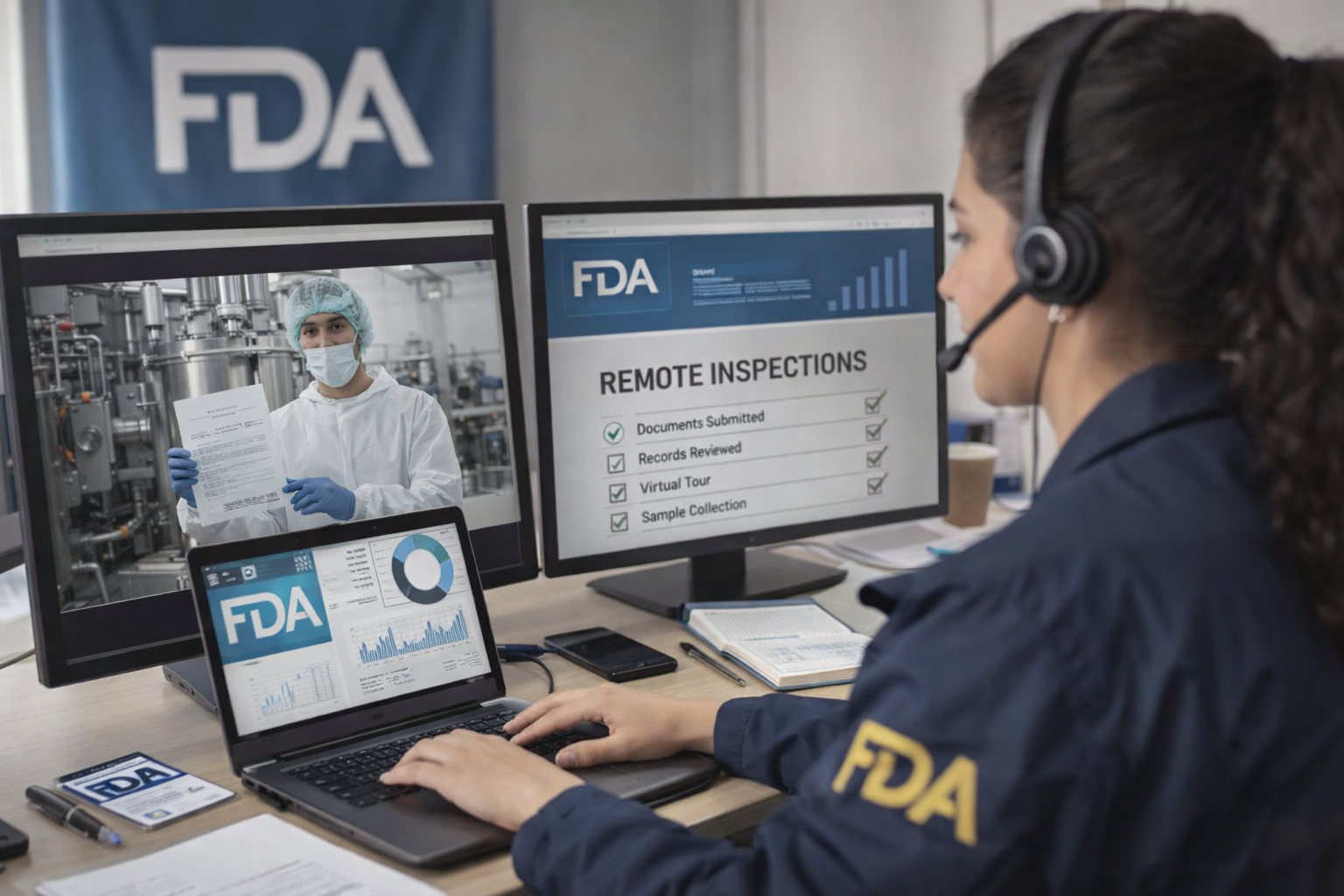
As of 2026, the FDA’s oversight has undergone a permanent, digital transformation. The traditional “waiting for the knock at the door” strategy is obsolete. With the full implementation of the Quality Management System Regulation (QMSR) and the maturity of Remote Regulatory Assessments (RRAs), pharmaceutical and medical device manufacturers are now subject to a “perpetual inspection” environment. Practicing these mock Remote FDA Inspection (RRA) with our team of former FDA investigators is no longer a luxury, it is a survival requirement for your market authorization. A mock Remote Regulatory Assessment (RRA) is not a “voluntary conversation,” it is a high-stakes examination of your quality. Under CP 7382.850 and CP 7356.002, the FDA can issue a Warning Letter without ever stepping foot on-site or issuing a Form 483.

Warning Letter from RRA
The January 2026 Warning Letter to Unomedical (Mexico) is a blueprint for why Remote Regulatory Assessments (RRA) are high-stakes. Even without a Form 483 issued during the digital phase, the FDA escalated to a Warning Letter because the firm’s remote data revealed systemic quality failure. The “Digital Refusal” Risk, the FDA now treats a delay in uploading RRA records as a violation of Section 704(a)(4). In the Unomedical case, the failure to provide comprehensive risk management data during the assessment led the FDA to conclude that the firm lacked control over its Design Change and CAPA systems.
Another example, during a 2024 RRA of a sterile drug facility in Mexico, the firm failed to provide requested aseptic processing videos and environmental monitoring logs within the 24-hour digital window. Despite no on-site 483 being issued, the FDA determined the firm’s “refusal” to provide records promptly constituted a violation of Section 704(a)(4). This resulted in a Warning Letter and an immediate Import Alert, effectively shutting down their U.S. market access entirely from a remote desk in Maryland.
The FDA’s authority to conduct Remote Regulatory Assessments (RRAs) for drug manufacturers is not just a policy, it is a federal law.
The requirement is explicitly stated in two primary locations: Section 704(a)(4) of the Federal Food, Drug, and Cosmetic (FD&C) Act and the July 2024 (Finalized June 2025) Guidance for Industry.
The Statutory Authority: FD&C Act Section 704(a)(4)
This is the legal “engine” behind the RRA. In 2012 (via FDASIA) and expanded in 2022 (via FDORA), Congress gave the FDA the power to request records from drug manufacturers “in advance of or in lieu of an inspection.”
- What it says: It mandates that any establishment engaged in manufacturing, preparing, propagating, compounding, or processing a drug shall provide records upon request to the FDA.
- The Penalty: Because this is a mandatory RRA, refusing to provide these records or delaying them is considered a violation of the Act. This is exactly what happened in the Unomedical case; they failed to provide sufficient digital evidence, leading to a Warning Letter.
FDA Final Guidance: “Conducting Remote Regulatory Assessments” (July 2024)
This is the “how-to” manual for investigators and industry. It explicitly lists Drug Manufacturers as the primary subject of mandatory RRAs.
- Center for Drug Evaluation and Research (CDER) Integration: The guidance was co-authored by CDER and specifically states that RRAs apply to human and animal drugs, biologics, and APIs.
- Mandatory vs. Voluntary: It clarifies that while some remote activities are voluntary, Drug and Device record requests under 704(a)(4) are mandatory.
- Direct Link: You can find this on the FDA Website here.
- Are you ready? If not, mock a Remote Regulatory Assessment with us.
Compliance Program (CP) 7356.002 Revisions
While the original CP 7356.002 was designed for on-site visits, the 2023/2024 revisions now instruct investigators to review any information gathered during a preceding RRA.
- The Systems Approach: The CP now treats the RRA as “pre-inspection intelligence.” Investigators use the data retrieved remotely (under the 704 authority) to build their on-site audit plan.
- Data Integrity Focus: The CP 7356.002 instructions now include verifying that the digital records sent during an RRA match the raw data found on the servers during the physical visit.
The Digital Shift: RRAs are the New Standard
Under the 2026 guidelines for CP 7356.002 (Drugs) and CP 7382.850 (Devices), the FDA now utilizes RRAs to conduct mandatory record reviews under Section 704(a)(4). Unlike a physical inspection, where you have time to “stage” the facility, an RRA requires an instantaneous digital response. If your electronic systems are not “audit-ready” at a moment’s notice, a remote assessment can quickly escalate into a “For Cause” on-site inspection, bringing with it a higher level of scrutiny and a greater likelihood of a Warning Letter.
Why You Must Remote Mock FDA Inspection or Remote Regulatory Assessment: The “Virtual War Room”
Hosting a remote investigator requires a completely different skill set than an in-person visit. In a physical audit, you can manage the pace through hallway conversations and lunch breaks. In an RRA, the investigator’s focus is hyper-concentrated on your Data Integrity.
- Forensic Scrutiny: Remote investigators often request live screen-sharing of your Audit Trails (ALCOA+). Without practice, your Subject Matter Experts (SMEs) may inadvertently expose non-compliant data or “orphaned” records while navigating the software.
- The Virtual Tour Trap: Shaky cameras or poor audio during a virtual facility walkthrough signal a lack of control. We train your “Camera Scouts” to provide a stable, professional feed that mirrors the confidence of a world-class manufacturing site.
Closing the Gap in 2026 Compliance
With the retirement of QSIT and the rise of the Six-System Model, the FDA is looking for “Quality Management System Regulation” (QMSR). They are no longer just checking if you have an SOP; they are checking if your digital systems automatically enforce it. Our mock Remote Regulatory Assessment simulates the high-pressure environment of 2026, testing your team’s ability to retrieve documents in minutes, defend technical decisions via webcam, and maintain “Professionalism, not Servitude” in a digital space.
By the time the FDA sends their RRA request, it’s too late to fix your digital architecture. Practicing with us ensures that when the “Virtual Knock” comes, your systems are seamless, your SMEs are calm, and your compliance is undeniable.
Remote Regulatory Assessment (RRA)
To prepare for a mock FDA Inspection, Remote Regulatory Assessment (RRA), you must shift your mindset from “Facility Hospitality” to “Digital Architecture.” In an RRA, the investigator’s experience is entirely dependent on the network speed, camera stability, and document organization.
Under the 2026 guidelines for CP 7356.002 (Drugs) and CP 7382.850 (Devices), here is how to build your RRA hosting strategy:
How to Prepare an RRA?
1. Preparation: The Digital Infrastructure
The “Back Room” is now a virtual environment. You must stress-test your technology before the FDA logs in.
- Secure Document Portal: Use a platform like Veeva, MasterControl, or a dedicated SharePoint. Ensure the investigator has “View Only” access. They should not be able to download or delete files unless specifically requested and approved.
- The “Clean Room” Screen Share: Dedicate a laptop for screen sharing that has zero desktop icons, no active email/Slack notifications, and a neutral background.
- Hardware for Virtual Tours: Use a high-definition mobile camera mounted on a gimbal (stabilizer). Shaky, handheld video is the #1 complaint from investigators during remote tours.
- High-Quality Audio: SMEs must use noise-canceling headsets. Background factory noise can make an SME sound uncertain or evasive when they are simply being drowned out by machinery.
2. Hosting: The Virtual “Front Room” Protocol
Hosting an RRA requires stricter “traffic control” than an on-site visit because you cannot see the investigator’s body language as easily.
- The Virtual Hub: Use a platform like Microsoft Teams or Zoom. Have a “Main Room” for the investigator and a private “Breakout Room” for your internal team to caucus before answering difficult questions.
- Document Presentation: When showing a document via screen share, have a “Pilot” (technical lead) and a “Navigator” (the SME). The Navigator explains the content while the Pilot scrolls and highlights the specific sections mentioned. Never scroll too fast; it looks like you are hiding information.
- Managed Chat: Disable the “Chat” function for the investigator. All requests should be verbal and recorded in your internal “Request Tracker” so nothing falls through the cracks.
3. The Virtual Facility Tour
This is the highest-risk part of an RRA. If the connection drops or the camera angle is poor, the FDA may terminate the RRA and trigger an immediate On-Site “For Cause” Inspection.
- Pre-Record “B-Roll”: While the FDA prefers live video, have pre-recorded, high-quality clips of difficult-to-reach areas (like inside an isolator or a crawl space) ready to show if the live feed fails.
- The “Scout”: Have a staff member walk 30 seconds ahead of the camera team to ensure floors are clear, PPE is perfect, and no unauthorized “post-it notes” are stuck to equipment.
- Audio Relay: The person holding the camera should not be the one talking. Have an SME in a quiet room narrating what the camera is seeing to ensure crystal-clear communication.
4. Data Integrity Verification
In an RRA, the FDA will likely ask for a Live Audit Trail Review.
- Remote Desktop Protocol (RDP): Be prepared to give the investigator a “Remote View” of your LIMS or CDS (Chromatography Data System).
- The “Pilot” Role: A trained analyst must drive the software while the investigator watches. The analyst must be expert enough to navigate to any date/time stamp in the audit trail within seconds.
Hardware and Software Checklist designed for a Digital War Room.
This ensures your facility is technically capable of hosting a seamless mock remote FDA Inspection, Remote Regulatory Assessment (RRA), under CP 7356.002 and CP 7382.850.
1. Connectivity & Network Infrastructure
The #1 reason RRAs fail is a dropped connection during a facility walkthrough.
- Dedicated Inspection Wi-Fi: Create a hidden SSID (Network) exclusively for the inspection team to prevent bandwidth throttling from other staff.
- 5G/LTE Failover: Ensure the “Camera Scout” has a mobile hotspot as a backup for “dead zones” (e.g., inside reinforced concrete warehouses or cleanrooms).
- Wired Connections: The “Front Room” Lead SME and the “Document Pilot” should always be on a hardwired Ethernet connection to prevent audio lag.
2. The “Virtual Tour” Hardware Kit
- Camera/Mobile Device: Use a high-definition device capable of 1080p/60fps. Older tablets often have grainy sensors that make label reading impossible.
- 3-Axis Gimbal (Stabilizer): Mandatory. Handheld “walking” video is unprofessional and causes “motion sickness” for investigators.
- External Directional Microphone: A clip-on lavalier or a directional “shotgun” mic is required to filter out ambient factory noise (HVAC, machinery) so the SME can be heard clearly.
- High-Intensity Portable Lighting: Necessary for inspecting dark areas like mechanical interstitial spaces or the undersides of large tanks.
3. Software & Digital Logistics
- The “Clean” Presentation Laptop: A dedicated machine with all notifications (Email, Slack, Teams) disabled. The desktop background must be a neutral company logo.
- Secure Document Portal (Veeva/SharePoint): * Set permissions to “View Only/No Download” by default.
- Ensure all PDFs are OCR-searchable (Optical Character Recognition).
- Collaborative Request Tracker: An internal-only dashboard (visible to the Back Room) to track the status of FDA requests: Requested → Located → Reviewed → Staged → Uploaded.
- Virtual “Caucus” Room: A secondary, private bridge for internal discussion. Rule: Never use the “Mute” button on the main bridge to discuss strategy; the investigator might still be listening. Move to the Caucus Room instead.
4. SME Digital Etiquette Checklist
- Eye Contact: Look into the camera lens, not at the investigator’s face on the screen.
- Lighting: Ensure the SME is front-lit. Backlighting makes the SME appear as a silhouette, which feels “evasive” to an investigator.
- The “Pilot” Sync: The person scrolling the document must wait for the SME to finish a sentence before moving to the next page.
Why does this matter?
A technical glitch during an RRA is often viewed by the FDA as a “lack of management control.” If you cannot maintain a stable video feed of your sterile fill line, the investigator may conclude that your Facilities & Equipment System is not properly maintained.
SME Preparation
This script is designed for the Lead SME and the Camera Scout to use the moment the virtual tour begins. It establishes immediate “Professionalism, not Servitude” and demonstrates that your facility is in total control of the digital environment.
The Virtual Tour: Opening 5-Minute Script
Location: Gowned and ready at the entrance to the Production or Laboratory floor.
Participants: Lead SME (Narrator), Camera Scout (Operator), and the Digital Pilot (Back Room Monitoring).
0:00 – 0:01: The Visual Handshake
Lead SME: “Good morning, Investigator [Name]. We are now beginning the virtual tour of our [Drug/Device] Manufacturing area. To ensure a high-quality experience for you, I am accompanied by a dedicated camera operator using a stabilized feed. Can you confirm that you can see my video and hear my voice clearly before we enter the controlled zone?”
- Wait for confirmation. If audio is laggy, the Digital Pilot in the War Room should troubleshoot immediately.
0:01 – 0:02: Setting the Digital Rules of Engagement
Lead SME: “For today’s tour, I will narrate our location and the processes currently in operation. If you would like a closer look at a specific label, gauge, or piece of equipment, please let me know. I will instruct the operator to ‘Hold’ and ‘Zoom’ to ensure the image remains stable for your review. We will maintain a steady pace to prevent motion blur.”
0:02 – 0:03: The “Entry” Integrity Check
Lead SME: “We are now entering the gowning area for Suite [X]. You will observe our personnel following SOP-[Number]. We have verified that the differential pressure gauges are within the validated range of [X] to [Y] pascals. Operator, please ‘Hold’ on the magnehelic gauge for the Investigator.”
- The Operator holds the camera steady on the gauge for 5 seconds. No shaking.
0:03 – 0:05: Contextualizing the Six-System Model
Lead SME: “As we move toward the [Fill/Assembly] line, you are seeing our Facilities and Equipment System in active status. This equipment was last qualified on [Date]. All sanitation logs are available in the Digital War Room for your immediate request. We are currently processing Lot [Number] of [Product Name].”
Critical “Virtual Tour” Commands for the Team
To keep the tour professional, the Lead SME should use “Director Commands” so the Investigator doesn’t have to guess what is happening:
- “Pan Left/Right”: Move the camera slowly to show the surrounding environment.
- “Hold and Focus”: Stay perfectly still on a document, screen, or serial number.
- “Transitioning”: Use this when moving between rooms where Wi-Fi handoffs occur (this alerts the Investigator that a 1-second flicker might happen).
- “SME Interface”: Use this when you are bringing a specific line operator on camera to answer a technical question.
Remote FDA Inspection (Regulatory Assessment) Traps and Rebuttals
In the high-pressure environment of a live virtual tour, investigators often use “trap” questions to see if an SME will speculate or deviate from the validated process. The goal is to remain helpful without over-sharing or guessing.
Here are the SME Rebuttal & Pivot Phrases for your 2026 Playbook. These are designed to maintain Professionalism, not Servitude.
The “Speculation” Trap
- Investigator: “It looks like that operator is skipping a step in the gowning SOP. Is that standard practice here?”
- The Trap: Getting defensive or guessing why the operator did what they did.
- The Rebuttal: “I want to ensure I give you a technically accurate answer based on the current version of the SOP. Let’s have the Back Room pull SOP-[Number] and the training record for this operator so we can review the specific requirement together on the screen share.”
The “Memory Test” Trap
- Investigator: “What was the exact pressure limit for this isolator during the last PQ (Performance Qualification)?”
- The Trap: Quoting a number from memory that might be slightly off, creating a “Data Integrity” conflict.
- The Rebuttal: “The validated limits are defined in our Master Validation Plan. Rather than reciting a figure from memory, I will have the Pilot display the Summary Report for PQ-[Year] so you can see the precise parameters and the actual results achieved.”
The “Hypothetical Failure” Trap
- Investigator: “If this sensor failed right now, would your system catch it, or would you ship a defective product?”
- The Trap: Saying “I think so” or “probably.”
- The Rebuttal: “Our system is designed with redundant controls. The specific ‘Failure Mode’ and ‘Detection’ logic are documented in our FMEA (Failure Mode and Effects Analysis) for this line. I can have that risk assessment ready for your review in the War Room in five minutes.”
The “Negative Inference” Trap
- Investigator: “Why isn’t there a logbook entry for this cleaning yet? Are you waiting until the end of the shift to ‘backfill’ it?”
- The Trap: Admitting to poor documentation habits or getting flustered.
- The Rebuttal: “Our policy requires contemporaneous documentation. I will check the Electronic Batch Record (eBR) status with the area lead. If there is a delay in the entry, we will document the reason per our Good Documentation Practices (GDP). Let’s verify the audit trail for this timestamp now.”
CP 7356.002 & CP 7382.850
Mock Remote FDA Inspection or Regulatory Assessment (RRA) by Former FDA Investigator
The 2026 "Pivot" Strategy
In a CP 7382.850 (Device) or CP 7356.002 (Drug) inspection, if you don’t know the answer, use the “Consult the Source” pivot:
“That is a specific technical detail managed within our [Quality/Production] system. To ensure accuracy, I will consult the official record and provide you with the verified data shortly.”
Why RAQA Consulting?
By training your clients to use these phrases, you are teaching them to control the narrative. A former investigator respects an SME who says, “I will get you the exact data,” much more than one who guesses and later has to retract a statement.
Remote Regulatory Assessment (RRA) FAQs
As former FDA investigators, we know that a Remote Regulatory Assessment (RRA) is not a “casual check-in”—it is a formal, high-stakes examination of your quality systems. In 2026, the FDA will use RRAs to determine your facility’s compliance status before they even arrive on-site. Here are the critical answers your team needs to stay prepared.
Is a Remote Regulatory Assessment (RRA) mandatory for Drug and Device manufacturers?
Can the FDA issue a Warning Letter based solely on an RRA?
Absolutely. While an RRA is not technically a “Section 704 inspection,” the findings from an RRA are official regulatory evidence. If the digital records provided reveal systemic failures in CAPA, Risk Management, or Data Integrity, the FDA can and will issue a Warning Letter without a physical visit. The January 2026 Unomedical case proves that a failed remote data submission can lead directly to severe enforcement.
How much time do we have to upload requested documents?
Will an RRA replace my next on-site FDA inspection?
Not necessarily. The FDA often uses an RRA as a “Pre-Inspection” tool to narrow its focus. If your RRA goes poorly, it will almost certainly trigger a “For Cause” on-site inspection with a higher level of scrutiny. Conversely, a successful RRA demonstrating high quality may allow the FDA to conduct a shorter, abbreviated on-site audit.
What is the "Digital Refusal" rule?
Does ICH Q7 apply to Remote Assessments for APIs?
Yes. If you manufacture Active Pharmaceutical Ingredients (APIs), the FDA will use the ICH Q7 standard to evaluate your remote data. They will focus heavily on Section 7 (Materials Management) and Section 19 (Clinical APIs), looking for forensic proof that your “Starting Materials” and impurity profiles are fully documented.
Contact us today to mock Remote FDA Inspection or Regulatory Assessment (RRA)
We invite you to contact us today to learn how we can join your quality assurance team. We’re here to help you ensure the highest standards of quality and safety for your medical devices and pharmaceuticals.