
FDA Inspection Strategy and FDA Consulting
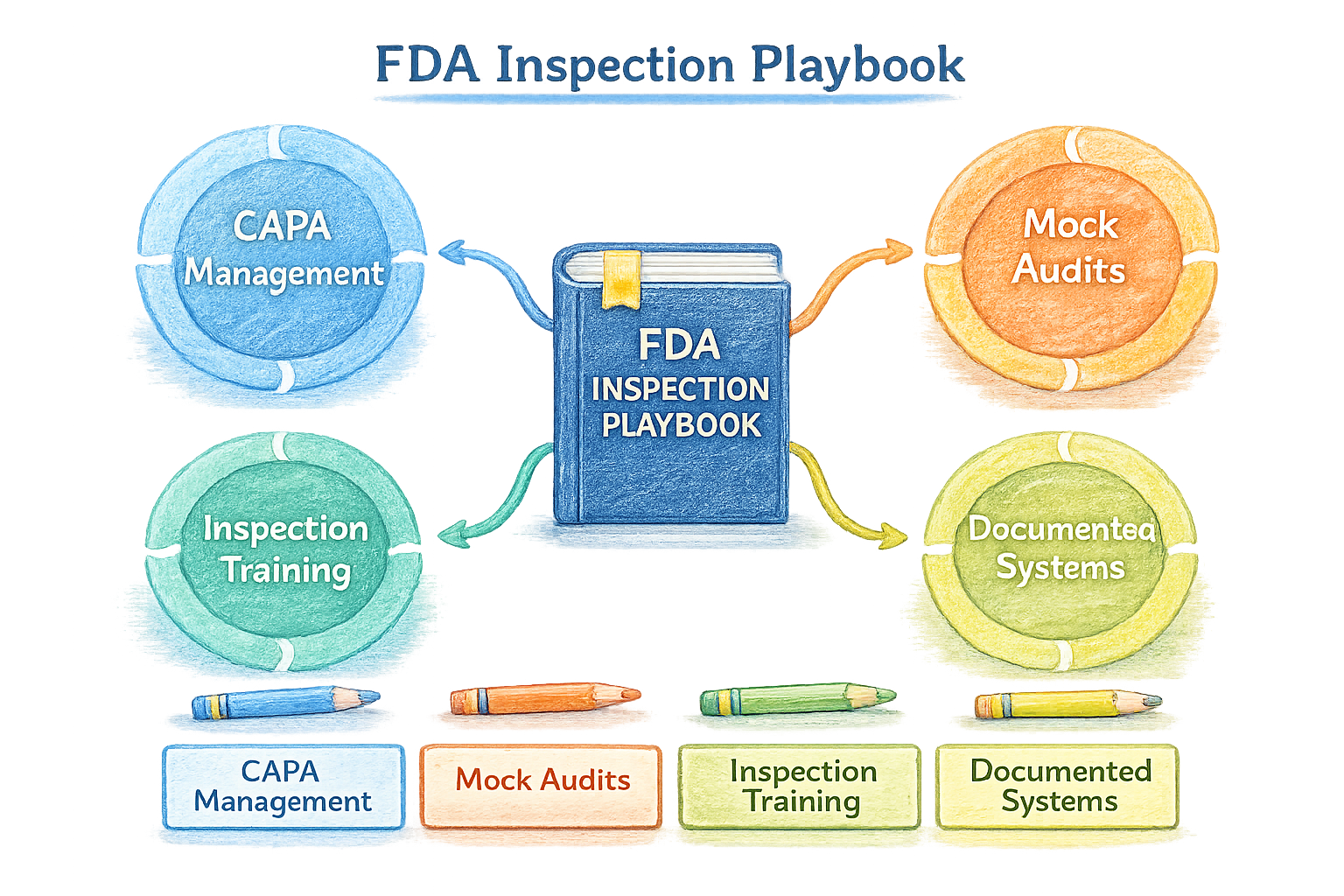
FDA Inspection Playbook
The Agency does not schedule inspections around a manufacturer’s preferred timetable. It selects drug and device establishments through statutory risk-based schedules. Relevant factors include compliance history, recalls, product risk, previous inspections, and other regulatory priorities. Some inspections receive advance notice, while others may occur without notice. The approach depends on the inspection type and circumstances. Manufacturers should therefore maintain readiness rather than rely on a predictable calendar.
An inspection playbook is more than a checklist. It establishes how systems operate, how records support decisions, and how personnel manage requests and questions. An FDA mock inspection can test that playbook under realistic conditions. The exercise should assess implementation, objective evidence, document retrieval, communication, and escalation.
Organisations that rely on timing or long inspection gaps accept unnecessary compliance risk. A mock FDA inspection can reveal weaknesses before an Agency visit. Regulatory consulting can help align operations with applicable requirements and current inspection practices. These services support preparation but cannot guarantee compliance or a particular inspection outcome.
Who Is FDA Office of Inspections and Investigations (OII)
The Agency established OII through the October 2024 reorganisation of the former Office of Regulatory Affairs. OII leads field inspections, investigations, import operations, emergency response, and law-enforcement activities. Its personnel collect evidence and provide insights that support fact-based Agency decisions. OII does not independently make every compliance or enforcement decision.
The office operates across the United States, its territories, and more than 90 countries. Current Agency figures state that OII conducts approximately 30,000 inspections and 10,000 investigations annually. An FDA mock inspection can help manufacturers rehearse document requests, interviews, and evidence-based reviews. It cannot reproduce every OII activity or guarantee a favourable inspection result. Understanding OII helps manufacturers prepare for the Agency’s field operations. Its personnel evaluate facilities, processes, records, data, and other evidence during authorised activities.
OII Conducts Inspections That Inform Regulatory Action
OII investigators inspect pharmaceutical, medical device, biological product, and other regulated establishments worldwide. They assess operations against applicable statutory and regulatory requirements. Investigators examine quality systems, production controls, records, facilities, equipment, and manufacturing practices. Their evidence may support inspectional observations and subsequent Agency decisions. An investigator may issue an FDA Form 483 after observing significant objectionable conditions. The form does not constitute a final Agency determination that a violation occurred. A mock FDA inspection can test whether records and operations provide objective evidence of compliance. However, the exercise cannot predict Agency findings or prevent regulatory action.
Investigates Beyond the Facility
OII conducts approximately 10,000 investigations annually. These activities involve consumer complaints, health fraud, product tampering, recall compliance, and public-health emergencies.
Investigations may examine products, records, distribution channels, imports, and other relevant evidence. The scope depends on the underlying concern and applicable authority.
The Office of Criminal Investigations operates within OII and handles alleged criminal conduct. It works with US attorneys, the Department of Justice, and other law enforcement partners.
Screens and Controls What Enters the U.S. Market
OII reviews regulated products offered for entry into the United States. Its import operations work at borders, ports, and international mail facilities. The Agency reports that OII makes more than 50 million import-admissibility decisions annually. Advanced screening technology reviews all regulated products of foreign origin entering the domestic market. This screening does not mean OII physically examines every shipment. The Agency may detain or refuse products that appear to violate applicable requirements. For global manufacturers, noncompliance can delay market entry and disrupt supply chains. It may also limit access to the US market.
Operates Continuously and Globally
OII works throughout the United States, its territories, and more than 90 countries. Its teams inspect facilities, investigate complaints, review imports, and coordinate with regulatory partners. The office also responds to emergencies and natural disasters involving regulated products. Its Emergency Operations Centre provides crisis coordination continuously throughout the year. OII’s global presence does not mean that every facility receives continuous monitoring. The Agency prioritises inspections and other activities according to risk, legal authorities, and programme needs. Manufacturers should therefore maintain continuous compliance and inspection readiness. They should not rely solely on previous inspection intervals.
Who Conducts FDA Inspections
Agency inspections generally involve investigators from the Office of Inspections and Investigations (OII). They may work with authorised regulatory partners in certain programmes. OII leads the Agency’s field inspection, investigation, import, emergency-response, and law-enforcement activities. An FDA mock inspection can help personnel practise document requests, interviews, and inspection interactions.
The Office of Criminal Investigations (OCI) operates within OII and serves as the Agency’s criminal law-enforcement arm. Its special agents may execute warrants, make arrests, carry firearms, and gather evidence. They investigate suspected crimes involving fraud, counterfeiting, illegal distribution, tampering, or deliberate records falsification.
OII investigators collect evidence concerning regulatory compliance, while OCI investigates suspected criminal violations. Civil and criminal matters may proceed simultaneously. A mock FDA inspection cannot reproduce a criminal investigation or predict OCI involvement. OCI involvement indicates possible criminal concerns beyond routine inspection activity. It does not establish guilt or prove that a crime occurred.
How FDA Actually Conducts Inspections
Agency inspections follow defined procedures, assignments, and applicable compliance programmes. Their scope and techniques vary by product, inspection type, risk, and available evidence. Investigators do not rely on one universal checklist. They review records, observe operations, interview personnel, and compare actual practices with written procedures. Reviews may cover CAPA, complaints, validation, production, suppliers, laboratory controls, and other relevant systems. The applicable requirements and inspection scope determine which systems receive attention.
Questions may change as evidence develops. An inconsistency can prompt additional review when it suggests a related compliance concern. Investigators assess whether the establishment complies with applicable requirements and maintains effective control. An FDA mock inspection should test implementation, traceability, record accuracy, and the evidence supporting decisions. Written system design matters, but consistent performance and objective evidence matter equally.
What to Do When an FDA Investigator Arrives
Agency investigators may arrive with or without advance notice, depending on the circumstances. For a domestic inspection, the investigator normally presents credentials and issues Form FDA 482. A designated, knowledgeable representative should accompany the investigator and coordinate requests. Inspection duration varies with scope, facility complexity, findings, record availability, and follow-up needs. Onsite work may extend across multiple days, so no organisation should assume a fixed timetable.
Investigators gather facts and document observations. The Agency later evaluates the evidence and makes compliance and enforcement decisions. Follow your inspection procedure, maintain an accurate request log, and provide complete records within the applicable timeframe. Personnel should answer truthfully and concisely. If they do not know an answer, they should confirm the facts before responding. Never guess, speculate, alter records, or create missing documentation to answer a request.
A mock FDA inspection helps teams practise these controls before an actual visit. You cannot control the duration, but preparation can support an orderly and efficient inspection.
What Are FDA Investigators Actually Looking For?
Investigators gather evidence to assess compliance with applicable laws and regulations. They do not make the Agency’s final inspection classification while standing in the facility. Instead, they examine operations, review relevant records, interview personnel, and collect samples when appropriate. Procedures alone cannot demonstrate implementation. Investigators compare written requirements with actions, data, timelines, and documented decisions. They may trace deviations, complaints, CAPAs, changes, and validation activities across connected systems. Reliable records should show what occurred and who acted. They should also explain decisions and demonstrate whether actions proved effective. Conflicting records, unsupported conclusions, or ignored trends may lead to additional questions and broader review.
An FDA Form 483, when issued, lists observations that may indicate objectionable conditions or practices. It does not represent the Agency’s final determination of violations. Effective readiness depends on accurate records, controlled operations, credible data, and consistent execution. An FDA mock inspection should verify those connections through realistic questioning and document requests.
What to Do and Not to Do
Do:
- Examine the investigator’s credentials and record their name and credential number. Expect FDA Form 482 at a domestic establishment inspection.
- Have the owner, operator, agent-in-charge, or most responsible onsite official receive the notice.
- Assign a knowledgeable escort and a separate request coordinator. The escort should facilitate access without obstructing the investigator.
- Activate your inspection-response procedure and maintain a contemporaneous request log. Record what the organisation provided and when.
- Use a mock FDA inspection to rehearse escort duties, document retrieval, interviews, escalation, and daily management briefings.
- Clarify ambiguous requests promptly, but never use clarification to delay a response.
- Provide records within the Agency’s inspection authority promptly. Escalate genuine authority questions without obstructing the inspection.
- Invite investigators to discuss observations as they arise or during daily meetings. Same-day discussion may not always be possible.
- Correct obvious issues through approved quality processes when safe and appropriate. The Agency views immediate voluntary corrections positively.
- Document every correction and its supporting evidence. An investigator may still report the underlying observation.
- Ask for clarification during the closeout meeting. Do not argue or seek consulting advice from the investigator.
- Submit a complete, evidence-supported response within 15 business days if the Agency issues FDA Form 483. The response remains voluntary.
Do not:
- Never refuse entry or unreasonably delay, deny, or limit authorised inspectional access. Section 501(j) may deem affected drugs or devices adulterated.
- Do not photocopy or photograph investigator credentials. You may examine them and record the identifying information.
- Avoid unreasonable delays because preferred employees are unavailable or records are inconvenient to retrieve.
- Explain legitimate delays and agree on a reasonable production time with the investigator.
- Never assume the inspection scope remains fixed. Evidence gathered during the inspection may change its depth or coverage.
- Do not guess, speculate, or provide unsupported explanations. Confirm the facts first.
- Never alter, backdate, recreate, conceal, or destroy records in response to an inspection.
- Avoid coaching personnel during interviews or interrupting truthful answers. Allow employees to respond from their own knowledge.
- Do not treat an FDA mock inspection script as approved answers. Personnel must respond truthfully and avoid rehearsed claims.
- Never assume an immediate correction will remove an observation or guarantee a favourable classification.
What to Say and Not to Say
Say:
- “Let me verify that and provide an accurate answer.”
- “Please clarify which record, date range, and format you need.”
- “Those records are stored off-site. We can retrieve them by this time tomorrow. Is that timeframe acceptable?”
- “Our designated contact will coordinate this request and confirm when we provide the records.”
- “I do not know the answer. I will confirm it with the responsible person and respond by [time].”
- “I need to correct something I said earlier. The accurate information is as follows.”
- “Would you discuss today’s inspection coverage and any observations or concerns identified so far?”
- “We have a documented safety or product-quality concern about photography here. May we explain it and discuss an alternative?”
These responses support accuracy, reasonable timing, and clear communication. The Agency recognises that some records require additional retrieval time. However, the organisation should provide a reasonable explanation and agree on a production timeframe.
A mock FDA inspection should teach personnel to provide factual answers rather than memorised scripts.
Do not say:
- “I think…”
- “Probably…”
- “We usually…”
- “That is how we have always done it.”
- “We do not have that,” before conducting a reasonable search.
- “That record does not matter.”
- “That is outside the inspection scope.”
- “You cannot take that photograph.”
- “Come back when our expert is available.”
- “I will create that document for you.”
- “We fixed everything,” without complete supporting evidence.
- “This is off the record.”
Unsupported statements, speculation, and unreasonable access restrictions can damage credibility. Some conduct may also delay, deny, or limit an inspection.
The Agency treats photography as an inspectional evidence-gathering method. Raise genuine safety or product-quality concerns through the designated contact. Do not impose a categorical prohibition without a documented reason and prompt escalation.
Never invent, alter, or recreate a missing record. State that the organisation has not located the record after completing a reasonable search. Then explain the applicable retention requirement, investigation, and corrective action when appropriate.
Best rule:
Answer truthfully, directly, and completely. Address the question asked, but include any context necessary to prevent a misleading answer. If you do not know, say so and commit to a reasonable response time.
An FDA mock inspection should test whether personnel can apply this rule under realistic questioning without guessing or relying on scripted answers.
How to Set Up Front Room and Back Room During an FDA Inspection
Manufacturers of any size may use a structured front-room and back-room model to coordinate an inspection. The Agency does not require this model; it is an industry management practice. The front room hosts direct interactions with investigators. The back room retrieves records, tracks requests, verifies information, and supports accurate responses. These rooms may be physical, virtual, or a combination of both. This structure should improve accuracy and organisation. It must never restrict investigator access, coach employees, filter evidence, or delay authorised requests. Investigators may speak directly with employees, observe operations, and request records within their inspectional authority.
A mock FDA inspection can test this structure and confirm that each participant understands their responsibilities.
Manage Requests With Speed and Control
When an investigator requests many records, clarify the scope and establish a reasonable production schedule. Provide responsive records as soon as reasonably possible. If phased production becomes necessary, explain the reason and obtain agreement on timing. Identify which records remain outstanding and when the team expects to provide them. Never assume that an initial production satisfies the entire request. Agency guidance identifies providing only some authorised records as conduct that may limit an inspection.
The back room may confirm document identity, version, date range, legibility, completeness, and responsiveness. It must not alter records, make unreasonable redactions, omit responsive information, or create unnecessary delays. Maintain a request log showing the request, assigned owner, receipt time, status, and exact records provided. Record any agreed deadlines and outstanding items. Speed supports the inspection only when the organisation also protects accuracy and completeness. An FDA mock inspection should test whether teams can produce records quickly without changing or withholding them.
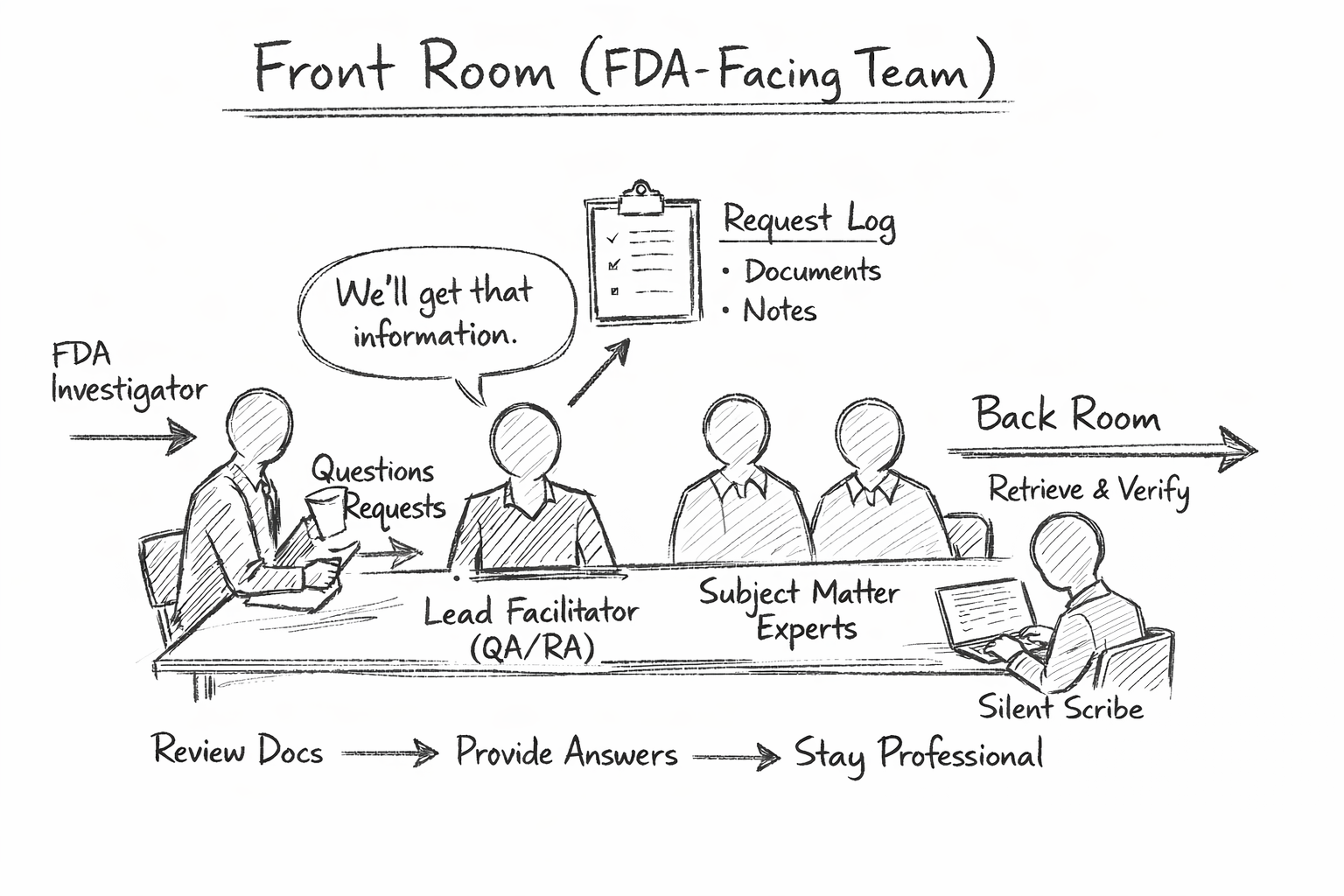
Front Room (FDA-Facing Team)
The front room serves as the primary interaction space. It usually includes a designated host, request coordinator, note-taker, and relevant subject-matter experts. The host coordinates communication but should not answer every question. Investigators may question employees directly about their responsibilities and actual working practices.
Each person should answer truthfully from their own knowledge. When someone does not know, they should say so and verify the information. Personnel should never rely on coached, memorised, or misleading answers. The request coordinator logs questions and documents requests. This person also confirms what the organisation provided and communicates reasonable retrieval times. A professional front room demonstrates organisation and accurate communication. It should not attempt to control the investigator or limit reasonable inspection activities.
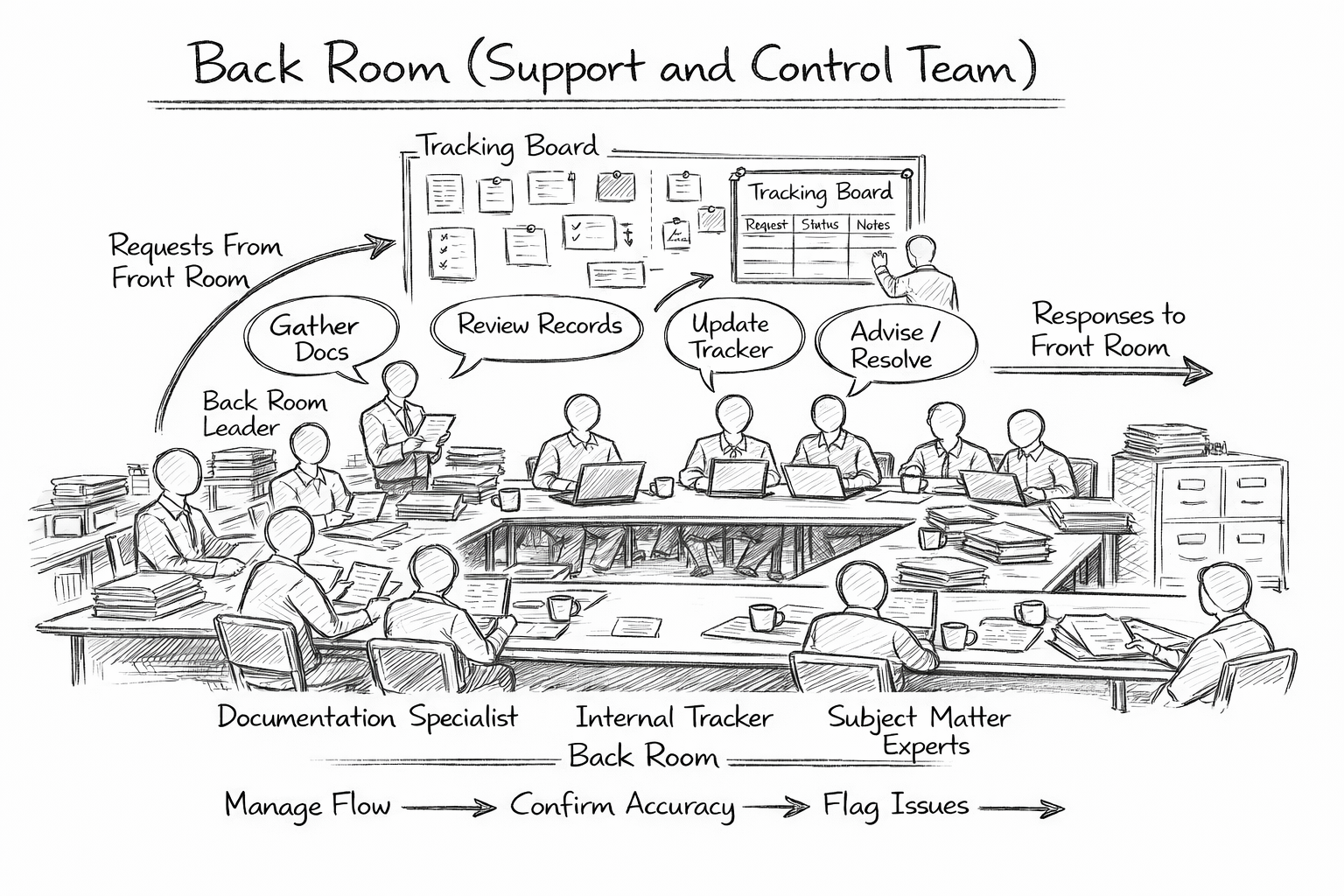
Back Room (Support and Control Team)
The back room locates, reproduces, and tracks requested records. Participants may include quality, regulatory, document-control, information-technology, data-integrity, and subject-matter specialists. Enter every request into the inspection log. Assign an owner and record the request time, due time, status, and exact production.
The team may perform an administrative quality check before release. Confirm the correct record, version, date range, completeness, and legibility. Preserve the original record and never change its content. Escalate missing, conflicting, or incomplete records immediately. Describe their status accurately and begin the appropriate internal quality process. Never create a replacement record or delay production while attempting a correction. Use an approved, secure method to provide electronic records. Preserve relevant file formats and metadata when the investigator requests them. When records require off-site retrieval or extensive compilation, explain the circumstances and agree on a reasonable timeframe.
A mock FDA inspection can verify that the back room supports prompt, complete, and accurate production. Its purpose is coordination—not concealment or selective disclosure.
The Back-Room Leader as Inspection-Response Strategist
In our inspection experience, the back-room leader often carries the broadest strategic responsibility. The front-room host must communicate carefully because every statement may influence the investigator’s review.
Outside the investigator’s presence, the back-room leader can facilitate candid internal discussions and challenge assumptions. This person verifies facts, reconciles inconsistencies, coordinates specialists, prioritises requests, and advises the front-room team. The ideal leader combines authority, judgement, quality-system knowledge, and inspection experience. This responsibility may require someone more senior or experienced than the front-room host.
However, the back room must support complete, accurate, and timely responses. It must never conceal evidence, coach misleading answers, alter records, or delay authorised access. Internal discussions and notes are also not automatically legally privileged.
Using Former FDA Experience in the Back Room
In our experience, engaging a former FDA investigator as a back-room adviser can provide significant strategic value during an inspection. A qualified former investigator can interpret requests, anticipate follow-up questions, identify inconsistencies, prepare subject-matter experts, and guide escalation decisions. This adviser understands how investigators connect records, statements, and operational evidence. That perspective can help the response team remain accurate, organised, and prepared as the inspection develops.
The consultant must not imply special access, influence, or certainty about inspection outcomes. The organisation remains responsible for every statement, record, and compliance decision. Because the consultant left federal service more than seven years ago, the usual time-limited restrictions have expired. Nevertheless, the consultant should confirm that no matter-specific conflict applies.
Core Roles During an FDA Inspection
An inspection-response team benefits from clearly defined roles. However, the Agency does not prescribe these titles or require this staffing model. Smaller organisations may assign several responsibilities to one qualified person. Each responsibility should still have a clear owner and backup.
An FDA mock inspection should confirm that the team has enough capacity and understands every handoff.
- Senior Management Representative: Opening and Closeout Meetings. The owner, operator, agent-in-charge, or most responsible onsite official should receive the investigator. The site leader or senior quality representative should normally attend the opening meeting. CEO participation remains optional and should serve a clear purpose. Appropriate senior management should attend the closeout meeting whenever possible.
- Receptionist: First Contact. The receptionist should greet the investigator professionally and promptly notify the designated inspection contact. Normal visitor safety and security procedures may apply. Never require unnecessary waiting or use a safety video solely to create preparation time.
- Front-Room Leader. This person coordinates direct communication, document requests, meeting schedules, and subject-matter expert participation. The leader promotes accurate and consistent responses but does not control what employees may say. Investigators may speak directly with personnel about their responsibilities and working practices.
- Back-Room Leader. This person manages the request log, assigns owners, prioritises retrieval, and escalates potential problems. Whenever practical, appoint one of the organisation’s most knowledgeable quality-system leaders. The individual should have sufficient seniority and authority to mobilise departments, set priorities, and escalate issues promptly. No single leader must know every technical detail. However, they should understand system interdependencies and know which subject-matter experts to involve. The leader checks that records match each request and remain complete and legible. No review should alter records, omit responsive information, or create unreasonable delays.
A mock FDA inspection should test the handoff between the front-room and back-room leaders under realistic time pressure.
- Scribe. The scribe takes contemporaneous notes covering questions, answers, requests, document identifiers, commitments, and timing. This person normally observes rather than leads the discussion. Audio or video recording requires separate legal and organisational consideration.
- Escort. The escort accompanies the investigator and explains applicable safety, gowning, security, and contamination-control requirements. This person facilitates reasonable access and observes inspection activities. The escort must not obstruct movement, block employee interactions, or delay the inspection.
- Document Transfer Coordinator. This person securely transfers records between the back room and front room. Electronic inspections may not require a physical runner. The coordinator should track every file, delivery time, and outstanding item.
- Subject-Matter Experts. Specialists answer technical questions concerning their assigned responsibilities. They should respond truthfully, concisely, and from their own knowledge. When uncertain, they should acknowledge that uncertainty and verify the facts. The organisation should never provide coached or memorised answers.
- Information Technology or Data Specialist. This person supports electronic record retrieval, system demonstrations, metadata, audit trails, and secure file transfers. The specialist must preserve original records and explain system functions accurately.
- Inspection Adviser: Optional. A qualified consultant, including a former FDA investigator, can advise the back-room leader during the inspection. This adviser may interpret requests, anticipate follow-up questions, identify inconsistencies, and guide escalation. The consultant must not imply special influence or replace the organisation’s responsibility for its responses.
- Legal Counsel: As Needed. Counsel may advise on genuine questions involving inspection authority, privilege, potential enforcement exposure, or post-employment conflicts. The team should escalate these questions promptly without creating unnecessary delays.
No universal staffing minimum applies to every manufacturer. The organisation should base its structure on facility size, product risk, inspection scope, and available personnel.
An FDA mock inspection can reveal overloaded roles, communication gaps, and document-retrieval bottlenecks before an actual inspection.

Establish an Internal FDA Inspection Playbook and Train Your SMEs
The Agency does not require manufacturers to maintain a document called an inspection playbook. However, many organisations formalise one to ensure consistent inspection responses. When the organisation treats its playbook as a quality-system document, apply the relevant document-control requirements. Define responsibilities, backups, communication pathways, document handling, escalation, and request tracking.
The playbook should address reception, front-room and back-room operations, escorts, interviews, electronic records, daily briefings, and closeout activities. It should also explain how personnel handle missing records, delayed retrieval, and questions concerning inspection authority. Applicable CGMP and quality-system requirements require qualified and appropriately trained personnel. They do not specifically require training on investigator interviews. However, interview-response training remains a valuable readiness measure. Subject-matter experts should answer truthfully from their own knowledge. They should avoid speculation and include any context needed to prevent a misleading answer.
A mock FDA inspection can test the playbook through realistic questions, record requests, and communication challenges. Experienced FDA Consulting support may also help train SMEs without scripting their answers.
Prepare the Front Desk and Coordinate SME Contacts
An inspection may begin at reception. The receptionist should remain professional, obtain the investigator’s name, and immediately notify the designated contacts. The owner, operator, agent-in-charge, or most responsible onsite official should examine the credentials. That official normally receives FDA Form 482 during a domestic establishment inspection.
Reception personnel must not photocopy or photograph investigator credentials. Normal visitor safety and security procedures may apply, provided they do not unreasonably delay or limit the inspection. The receptionist may record the arrival time, team size, names provided, immediate requests, and relevant statements. They should report this information exactly without assumptions or interpretation. Do not restrict the receptionist to one scripted sentence. If an investigator asks a substantive question, the receptionist should refer it to the designated contact without guessing.
A suitable response is:
“Welcome. I will notify our designated inspection contact immediately. They will meet you here shortly.”
An FDA mock inspection should test reception procedures, contact availability, notification speed, and the arrival log.
Conduct Periodic Internal FDA Inspection Drills
Inspection-response drills should simulate realistic arrivals, questioning, document requests, handoffs, and subject-matter expert interviews. No regulation establishes a universal drill frequency. Set the frequency according to product risk, organisational changes, inspection history, and previous drill results. Consider additional exercises after significant personnel, facility, process, or regulatory changes.
The exercise controller may test the initial notification process without advance warning. However, the controller should identify the exercise before requesting actual facility access or regulated records. A mock FDA inspection drill must remain clearly distinguishable from official government activity. Participants must never impersonate federal officers, display counterfeit credentials, or claim government authority.
Use separate activation messages:
“Training exercise—activate the inspection drill procedure.”
For an actual inspection, use:
“Actual Agency inspection—activate the inspection-response procedure.”
After each drill, document findings, assign responsible owners, and establish completion dates. Evaluate identified quality-system weaknesses through CAPA or another appropriate process.
Drills should assess performance, not merely confirm that a written procedure exists.
What Goes Wrong During an FDA Inspection
Many inspection problems arise from execution failures, even when procedures exist. Common examples include conflicting explanations, unavailable personnel, slow record retrieval, and incomplete document production. Communication creates additional risk when personnel speculate, overstate conclusions, or contradict approved records. Poor front-room and back-room coordination may also produce duplicate, inconsistent, or delayed responses. Investigators compare statements with records and observed practices. An inconsistency may prompt follow-up questions or broader review when it suggests a related compliance concern.
No single weak answer automatically expands an inspection. However, unsupported statements can direct attention towards connected records, systems, or decisions. Inspection problems may be technical, procedural, or operational. Even a well-designed quality system may appear uncontrolled when personnel cannot explain or demonstrate its implementation.
An FDA mock inspection can expose communication gaps, overloaded roles, retrieval problems, and inconsistent execution before an actual inspection.
FDA Forms 482, 483, and 484 — What Are They?
The Agency uses several forms at different stages of an inspection. Each form serves a specific purpose, and not every inspection involves all three. These forms may document notice, observations, or physical sample collection. They do not all represent findings or final Agency decisions. A mock FDA inspection should prepare personnel to receive, review, log, and escalate each form correctly.
Form 482 Notice of Inspection
At the start of most domestic inspections, the investigator presents credentials and issues a signed Form 482. The investigator normally gives it to the owner, operator, agent-in-charge or most responsible person present. The form provides written notice that the Agency is conducting an inspection under its statutory authority. It does not allege a violation or predict the inspection’s result. The FD&C Act does not require this notice during foreign inspections. For foreign manufacturers, Form 482 is generally not issued. Foreign inspections follow different notification and entry practices. The inspection team may provide identification or business cards, depending on the circumstances and established local arrangements.
Form 483 Inspectional Observations
At the inspection’s conclusion, an investigator may issue Form 483 when reportable observations exist. It lists conditions that may constitute violations, based on the investigator’s judgment. The document may not include every objectionable condition. More importantly, it does not constitute the Agency’s final determination.
Receiving a Form 483 does not mean the establishment has “failed” its inspection. Likewise, receiving no Form 483 does not guarantee that the Agency will identify no further concerns. The Agency later evaluates the inspection report, supporting evidence and the organisation’s response. It then determines the final inspection classification and whether further action is appropriate.
An FDA mock inspection should prepare management to discuss observations accurately and begin a controlled response process.
Form 484 Receipt for Samples
When an investigator obtains physical samples during an inspection, the investigator issues Form 484 at the inspection’s conclusion. The form describes the samples and serves as the establishment’s official receipt. Form 484 also records whether the samples were purchased, borrowed, or provided at no charge. Therefore, the form does not apply only to paid samples.
The Agency generally offers payment for samples, except in specified circumstances. Import samples are not paid for when collected. Under 21 CFR 1.91, the Agency pays for compliant import samples but not samples found violative. Samples collected under a court order or following seizure generally are not purchased. These payment exceptions do not remove the requirement to document samples taken during an establishment inspection.
Form 463a Affidavit
The Agency may use Form FDA 463a or another affidavit to document material facts from a knowledgeable individual. The individual should provide only facts they can personally verify. Before signing, the individual should read the complete statement and correct any inaccuracies. They must affirm that the statement is true and accurate. The investigator then witnesses the signature and affirmation; a separate notary is not necessarily involved.
A person may request legal counsel’s review before signing. However, that request should not create an unreasonable delay. If the person declines to sign, the investigator may document the refusal and its stated reason. Never sign an incomplete, inaccurate, or speculative statement. A mock FDA inspection should train personnel to recognise and escalate affidavit requests immediately.
A Well-Trained, Silent Scriber Is Essential
A dedicated scribe should document the inspection accurately and in real time. Although not required by the Agency, this role provides an important inspection-readiness control. The scribe records each request, response, document provided, timestamp, follow-up commitment, and significant investigator statement. Notes should remain factual and avoid speculation, interpretation, or legal conclusions.
A disciplined scribe normally remains silent and does not participate in substantive discussions. They should not answer technical questions or speak for the organisation. If directly addressed, the scribe should refer the question to the front-room leader. These notes support daily debriefings, request reconciliation, and consistent follow-up. They may also help the team recognise emerging concerns before the inspection concludes. The organisation should control, retain, and review inspection notes under its approved procedures. It should not assume that the notes carry legal privilege or confidentiality.
An FDA mock inspection can test the scribe’s accuracy, discipline, and coordination under realistic conditions. For structured scribe training, delivered remotely or on-site, contact CIRG.
Conduct Periodic Mock FDA Inspections
Do not wait for the Agency to test your systems. Schedule a periodic mock FDA inspection to evaluate performance under realistic conditions. Frequency should reflect product risk, operational changes, inspection history, significant CAPAs, and planned regulatory submissions. The exercise can simulate investigator questioning, record tracing, facility walkthroughs, and cross-functional pressure.
A well-designed simulation may identify weaknesses in execution, not merely documentation. It tests front-room discipline, back-room control, document retrieval, and SME responses under scrutiny. More importantly, it shows whether systems remain controlled when challenged.
Experienced FDA consultants can offer insight into current inspection methods and common areas of concern. Findings should support a prioritised remediation plan rather than promise a particular inspection outcome. If inspection readiness matters to your organisation, test it before the Agency does.